
A Guide to
Understanding Your Horse's Mouth
What's inside the mouth, how much space there really is, and why it matters for bit choice.
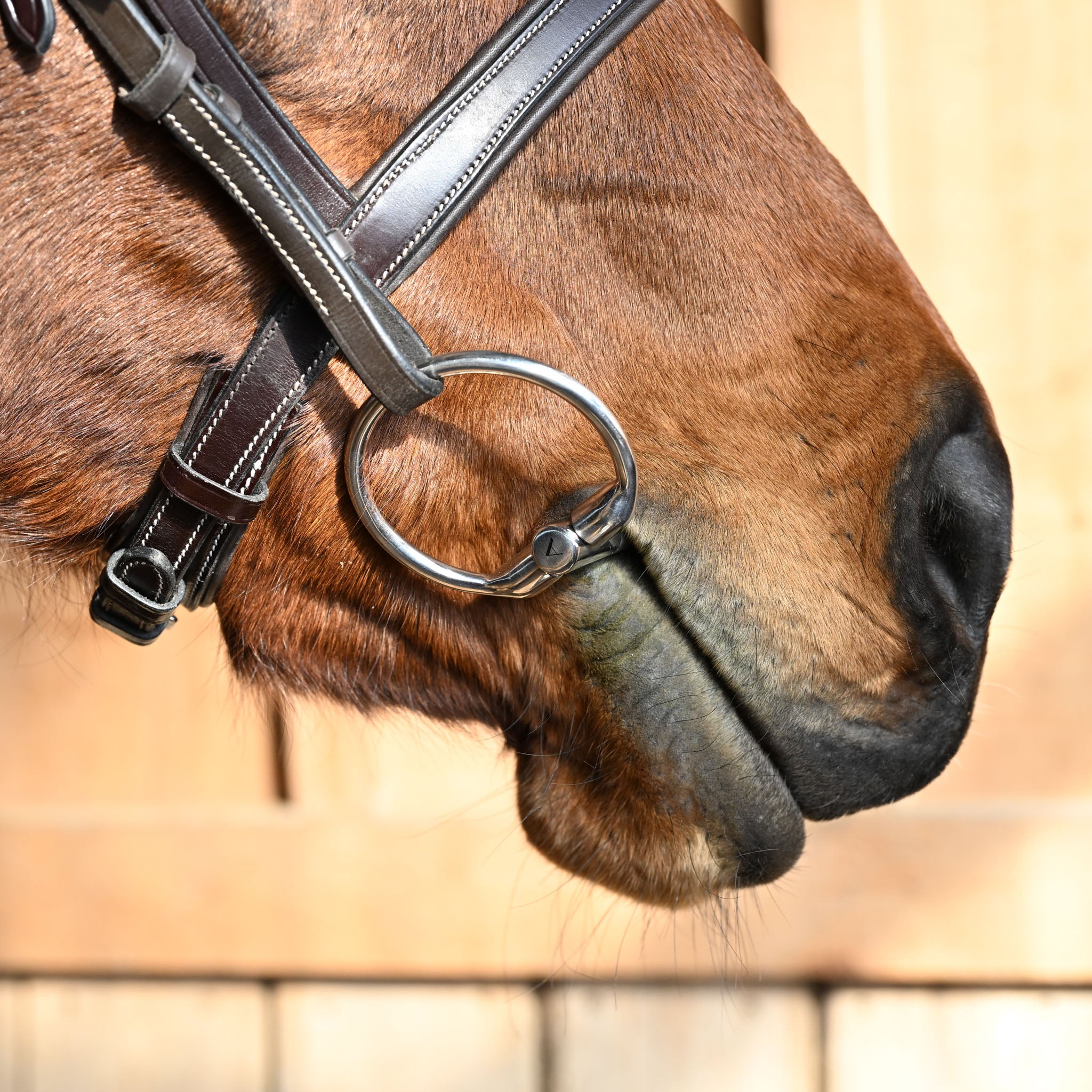
Before choosing a bit, it helps to understand the space it goes into.
A horse's mouth is smaller than most people expect. The tongue fills the entire oral cavity at rest. When a bit goes in, it shares that space with the tongue, sits over the bars of the lower jaw, and sits below the hard palate. The available room is measured in millimeters, not centimeters.
This guide covers each structure the bit interacts with, what it does, and why it matters for fit.
Anatomy at a glance
Six Structures of the Head That the Bit Interacts With

The Tongue
12 muscles, durable like a sponge. Connects to the shoulders, back, and hindquarters through the hyoid chain.

The Bars
The thin bones of the lower jaw. Only 2 to 3 mm of membrane over blood vessels and nerve endings.

The Lips
Inner lip fleshiness and length vary widely. Fleshy lips affect which mouthpiece shapes fit comfortably.

The Palate
The bony roof of the mouth. Depth varies dramatically between horses, which is why ports and lozenges need to match the individual.

The TMJ
The jaw joint behind the eye. Browband and noseband pressure here often masquerades as a bit problem.

The Teeth
Incisors, molars, and the vestigial wolf teeth that regularly disguise themselves as bitting issues.
Part 1
The Structures
Each structure in the horse's mouth does something different. How the bit feels depends on which structures it touches and how much padding there is between bit and bone.
The Tongue
The tongue is made up of 12 muscles. It can deform and reform almost like a sponge, and it handles pressure well, making it the best contact point in the mouth for a bit. But "durable" doesn't mean insensitive. It still feels pressure, heat, and taste.
The tongue protects the bars. When rein tension is applied, the tongue cushions the bit against the lower jaw. If a horse pulls the tongue back or over the bit, the bars lose that cushion and take direct contact. That's when bruising, rubs, and bone spurs happen. Tongue evasions are almost always the horse trying to escape pressure, not misbehaving.
The tongue connects to the body. It attaches to the hyoid bone at the back of the jaw, which connects onward to the shoulders and sternum all the way to the hind legs. Tongue tension doesn't stay in the mouth. A tense tongue can mean shortened stride and tight neck carriage.
Deeper Reading
Tongue, Hyoid and Body Connection
The anatomy behind what's actually happening when tension shows up in the mouth.
A study at Helsinki University measured tongue depth (top to bottom) across a range of horses. Minimum: 9 mm. Maximum: 22 mm. Average: 15.8 mm.
That's a huge range. A horse with a 22 mm tongue has very different needs than a horse with a 9 mm tongue, even if they have the same head size.
The tongue attaches to the hyoid apparatus, a chain of small paired bones at the back of the jaw. The hyoid is the central hub for three myofascial chains that run through the entire body:
1. Ventral chain (mouth to chest to pelvis): The sternohyoid and sternothyroid muscles connect the hyoid to the sternum. From there, the chain continues via pectoral and abdominal muscles into the pelvis. This chain is key for lifting the forehand and lowering the hind end.
2. Lateral chain (mouth to shoulders to limbs): The omohyoid connects the hyoid to the shoulder blade. The omothyroid connects it to the top of the forelimbs. The chain continues along the lower sides and down the hind legs to the toe. When the hyoid is tense, shoulder freedom is directly compromised.
3. Dorsal chain (mouth to poll to back to hindquarters): The occipitohyoid connects the hyoid to the poll. The nuchal ligament continues from the poll down the neck through dorsal back muscles to the hindquarters. This chain contributes to the horse's outline.
When the tongue and hyoid are relaxed, the horse can move freely through the shoulders, back, and hindquarters. When they're tense, that tension cascades: tongue tension, then neck and TMJ tension, then blocked shoulder, then hollow back, then blocked hindquarters, then disengaged abdominals. A horse taking short steps in front or showing a tense neck carriage may have a hyoid or TMJ issue, not a bit issue.
This connection is also why bits, used with knowledge and tact, are uniquely powerful: they give precise access to a structure that influences the whole body.
Reduced lateral movement, reduced neck range of motion, ventral neck tension causing the horse to go behind the bit to relieve it, hollow back, and shortened or stilted stride. The hyoid can also be injured, misaligned, or fractured by forceful tongue handling (such as aggressive dentistry) or restrictive tack.
The most common causes: a badly fitted bridle (too tight), tight nosebands, a badly fitted bit (wrong size or mouthpiece), harsh, heavy, or inconsistent rider hands, and gadgets used to force an outline such as draw reins.
The Bars
The bars are the thin bones of the lower jaw in the gap between the incisors and molars. Only 2-3 mm of mucous membrane covers them. Beneath that: blood vessels and nerves. Almost no padding.
When the tongue is in position, it covers and cushions the bars. When it's not (tongue over the bit, tongue pulled to one side), the bit sits directly on bone covered by a sliver of tissue. This is one of the most common causes of mouth injuries.
Bar shape varies by breed. Thoroughbreds and Arabians tend to have sharper, narrower bars. Warmbloods and drafts tend toward rounder. Sharper bars generally mean a more sensitive mouth.
Deeper Reading
Bars, Tongue and Lips in Detail
The structural details that influence which mouthpiece shapes will actually fit.
Yes. Warmbloods and Drafts typically have deeper, wider tongues. Thoroughbreds and Arabians tend toward thinner tongues. Ponies and Quarter Horses sit in between. But individual variation is large, so breed is a guideline, not a rule.
Roughly 1.5 to 2 finger widths between the left and right bars. If a horse withdraws its tongue to one side or pulls it back over the bit, the bit drops directly onto these narrow bones with almost no cushion.
Yes. Assess by gently peeling the lips inside out to view the inner surface. Fleshy horses, Warmbloods commonly, have excess inner lip tissue that can get caught in the joints of double-jointed bits, causing pinching. If the horse has fleshy inner lips, a barrel link or mullen mouthpiece may be more comfortable than a traditional lozenge or French link.
Average lip length (commissure to bottom of lower lip) is roughly 13 cm. This does not correlate with overall horse size. A 17hh horse may have a short lip. Lip length directly affects how many wrinkles form when the bit is in position. The "two wrinkles" rule is not universal, it depends on the individual horse's lip anatomy.
The Palate
The hard palate is the bony roof of the mouth. Despite the name, it's surprisingly delicate. It's made of irregular ridges (plicae) in mucous membrane, and beneath it sits the palatine plexus (a network of blood vessels) covered only by thin membrane. Almost no padding.
Palate depth varies from horse to horse and isn't reliably predicted by breed, age, or sex. Some horses have a deep, concave palate with clearance above the tongue. Others have a flat palate with almost no room. That's why mouthpiece features like ports, lozenges, and links need to be matched to the individual horse.
The soft palate sits further back. It averages 15 cm (6 inches) long and about 2.5 cm (1 inch) thick. It controls the opening and closing of the trachea entrance and only moves when swallowing. Horses are obligate nasal breathers, meaning they cannot breathe through their mouth. A horse cannot breathe and swallow at the same time.
"The available room inside a horse's mouth is measured in millimeters, not centimeters."
Part 2
The Research
Two cadaver studies give us the actual numbers on what fits inside a horse's mouth. The Helsinki tongue-depth data and the Engelke and Gasse palate and jaw measurements are what "14 mm max" is built on.
Deeper Reading
Internal Dimensions
What the studies actually measured, and what those numbers mean for mouthpiece thickness.
A study by Engelke and Gasse (2003) measured the internal dimensions of 72 equine cadavers where the bit sits. The measurements cover palate height (vertical clearance), palate width, and jaw distance (the vertical gap between the upper and lower jaws) across three categories.
Large breeds under 2.5 years:
- Palate height: 6 to 22 mm (average 13.6 mm)
- Palate width: 19 to 27 mm (average 23.0 mm)
- Jaw distance: 20 to 28 mm (average 24.0 mm)
Large breeds 2.5 years and older:
- Palate height: 9 to 25 mm (average 16.3 mm)
- Palate width: 21 to 35 mm (average 27.4 mm)
- Jaw distance: 25 to 44 mm (average 34.0 mm)
Ponies 2.5 years and older:
- Palate height: 10 to 25 mm (average 13.7 mm)
- Palate width: 20 to 30 mm (average 24.9 mm)
- Jaw distance: 26 to 43 mm (average 32.1 mm)
The tongue fills most of that jaw distance. The bit gets whatever room is left. With an average tongue depth of 15.8 mm, that leaves very little clearance for a thick mouthpiece. Many older bit designs at 22 mm or thicker leave almost no room for the tongue at all.
If the average tongue depth is 15.8 mm and the average jaw distance is 34 mm, that leaves roughly 18 mm of clearance above the tongue. But the bit also compresses the tongue downward, and the palate has limited depth. Based on the combined data from Helsinki and Engelke/Gasse, 14 mm is the practical maximum diameter that fits comfortably in most mouths.
Very thick mouthpieces don't spread pressure more kindly. They crush the tongue into structures with almost no padding.
Nearly. Engelke and Gasse found that pony internal dimensions are only a few millimeters smaller than those of large breed horses, even though their heads are much smaller externally. The average pony mouth is only about 10 mm narrower. External head size is misleading when choosing mouthpiece thickness or port height.
Yes. Both the width and height of the palatine arch change as the horse matures. A bit that fit at three may not fit the same horse at eight. The internal anatomy also doesn't correlate with external head dimensions at any age, so looking at the head shape alone won't tell you what's happening inside. It is not appropriate to choose a bit based on the horse's age, the only way to know is to assess the individual mouth.
The Jaw Joint (TMJ)
The temporomandibular joint sits behind the horse's eye and allows the 3-D jaw movement needed for chewing. When it becomes sore, the symptoms look a lot like bitting problems: head tilting, low-grade lameness, uneven muscle development.
Common causes of TMJ pain: tight browbands and noseband buckles pressing on or near the joint. These are regularly misdiagnosed as bit issues. Worth having checked before changing the bit.
The Teeth
A horse's mouth contains several types of teeth, and more than one of them can interfere with bitting.
Incisors are the front teeth (6 upper, 6 lower) used for cropping grass. They sit well forward of the bit and don't interact with it directly, but their wear pattern and alignment give clues about overall dental health and jaw balance.
Premolars and molars sit at the back of the mouth and are used for grinding. The first premolar position just behind the interdental space is where the bit sits. When you see bite marks on the bit these are the teeth that are typically interfering. Sharp edges or hooks on the front of the first premolar (a common result of uneven wear) can dig into the cheek when the bit moves backward under rein tension, causing pain that looks exactly like a bitting problem. Regular dental floating removes these edges.
Wolf teeth are vestigial first premolars that emerge around 5-12 months, right in the path of the bit. Not all horses grow them. When present, they sit just in front of the first grinding premolar and can cause significant pain and head-tossing.
Blind wolf teeth are worse. These never fully erupt and sit hidden under the gum. The bit presses gum tissue directly over the hidden tooth, and the horse reacts, but there is nothing visible to explain it. Many unexplained bitting issues trace back to blind wolf teeth. They require an experienced vet or equine dentist to find.
Canine teeth grow in the interdental space typically slightly below where the bit lies. They are found in most males and in about 25% of mares, erupting between ages 4-8. They can sit right in the path of the bit ring or mouthpiece, causing rubbing and discomfort. A bit fitted too low in the mouth is more likely to contact them. If canines are present and prominent, it is important to watch for any interference with the bit.
Any horse that suddenly becomes reactive, head-tossy, or resistant under rein should have its mouth examined before anything else changes.
Deeper Reading
Teeth, Dental Care and Salivation
Why dental health is the first thing to check when a horse becomes difficult in the mouth.
An adult horse has 36-40 permanent teeth: 12 incisors, 12 premolars, and 12 molars, plus canine teeth in most males and around 25% of mares. Horses have hypsodont teeth, meaning they continuously push through the gum throughout life. This is why regular dental checks matter for any horse in work. The wear pattern changes constantly.
Wolf teeth are vestigial premolars that sit just in front of the first grinding tooth, right in the bit's path. Most horses grow them to some degree. Canine teeth are a separate type entirely. They sit in the middle of the interdental space and are more common in males. Both can interfere with the bit, but in different positions and for different reasons. Wolf teeth are typically removed if they cause issues. Canine teeth are usually smoothed if they're sharp.
The bit sits in the interdental space and moves under rein tension. Any sharp edges on the first premolar, any unerupted wolf tooth, any prominent canine, or any jaw imbalance that causes uneven pressure across the mouth will interact directly with the bit's movement. Dental problems and bitting problems look almost identical from the outside. The safest assumption when a horse becomes difficult in the mouth is to rule out dental causes first.
Horses produce 35-40 litres of saliva per day, but only when chewing. Unlike dogs, they don't salivate in anticipation. Salivation during riding is a response to something in the mouth, not truly a sign of acceptance or relaxation.
A small amount of saliva is useful because it lubricates the bit and reduces friction. Over-salivation is a problem because horses can't breathe and swallow at the same time. They're obligate nasal breathers. Each swallow briefly blocks the airway. More swallowing during work means less oxygen and faster fatigue.
Many brands promote sweet iron and copper as encouraging "healthy salivation." A more nuanced view: a horse that is constantly chewing and mouthing the bit is likely inwardly fixating on the bit, not listening to other aids. The question is whether we want a horse that chews, or a nice still mouth that's listening.
The current evidence suggests not. Cook (2014) raised the concern, but Manfredi et al. (2005) found that the bit did not prevent swallowing during exercise. In fact, slight tongue compression from a bit may actually stabilize the larynx, potentially improving respiratory function. A study by Hillary Clayton examining 12 horses under four bitting conditions (head collar, snaffle, Myler, bitless) found no significant difference in swallowing frequency. A properly fitted bit does not meaningfully interfere with breathing.
Part 3
Common Myths
What the research actually shows about how bits behave in the mouth, and where popular understanding gets it wrong.
Deeper Reading
Bit Position and Common Myths
What the research actually shows about how bits behave inside the mouth.
Radiographic studies show that without rein tension, the bit sits on the narrowest part of the lower jaw, over the top of the tongue. When the rider picks up rein contact, the bit moves backward and upward in the mouth. Importantly, a single-jointed snaffle moves back about the same as a lozenge mouthpiece. There is no significant difference in how far back different mouthpiece designs travel.
No, a correctly fitted single joint bit should not interfere with the hard palate any more than the double-jointed equivalent.
This is one of the more widespread myths in bitting. Rein forces are directed toward the rider, not inwards or upwards. Remember the tongue is like a sponge that can absorb a fair bit of pressure. What actually happens: all jointed bits (single and double jointed) close around and squeeze the tongue when rein tension is applied.
The closure squeezes the commissures of the lips and the outer edges of the tongue. That is the only "nutcracker effect." The tongue gets compressed at the sides a little, depending on how much the bit can close around the mouth. This is also why correct mouthpiece sizing matters, so the pressure can be symmetrically delivered.
The only way the joint could push into the palate would be if there was a force pulling the bit upward from below. That would require pulling the reins straight down from the ground, which is not possible for a rider sitting in the saddle. In reality, for most freely moving jointed bits on a horse carrying its head on the vertical, the bit is pulled away from the palate. The closure cannot cause an upward push of a freely moving joint into the palate unless it has a very poorly designed locking mechanism.
There is no engineering reason to suggest that double-jointed bits close less than single-jointed bits under rein tension. Both types fold around the tongue. The difference is in how the pressure is distributed on the tongue surface and how the centre of the mouthpiece feels: a lozenge or French link contacts the tongue differently than a single joint, but the closing mechanism and force are the same.
- Wear gloves, especially with unfamiliar horses.
- Let the horse sniff your hand, avoid grabbing the nose.
- Check the tongue: depth, width, how prominent the genioglossus (bulky rear section) is.
- Check the inner lip tissue: fleshiness and length.
- Feel the bars from the side (not from the front due to bite risk).
- Check palate softness with a fingertip.
Do not force the exam. If the horse is head shy, do it over multiple sessions.
In Summary
The Practical Takeaways
- Thicker is not kinder. The tongue fills the mouth. 14 mm max suits most horses except those with thinner tongues.
- The bars have almost no protection. The tongue is the cushion. If the horse evades with the tongue, the bars are exposed.
- Palate depth varies. Match mouthpiece features to the individual horse.
- Ponies need the same internal space as horses. Don't downsize based on head size alone.
- The mouth connects to the whole body. Tongue tension cascades through three myofascial chains into the shoulders, back, and hindquarters. A tense mouth means a tense horse.
- The nutcracker myth is wrong. Jointed bits do not hit the palate. They squeeze the tongue and lip commissures. Single and double jointed bits close with the same mechanism.
- Rule out teeth first. Especially wolf teeth and blind wolf teeth.
- Look inside. External appearance tells you very little about internal space. The only way to know what a horse needs is to assess the individual mouth.
Where to Next
Not sure what your horse needs?
Browse Types of Horse Bits to see how different designs interact with these structures, or start with the Bit Guide to find the right fit for your horse.